Most companies don’t have a trade show program. They have a series of one-off booths that happen to share a logo.
It’s an easy trap to fall into. Each show gets planned in isolation — its own design cycle, its own budget conversation, its own last-minute scramble — because that’s how the calendar presents itself. But treated that way, every show starts from zero, and none of the work from the last one carries forward.
Here’s what changes when you stop planning show by show and start building a program instead.
Design shared, modular components — not one-off builds
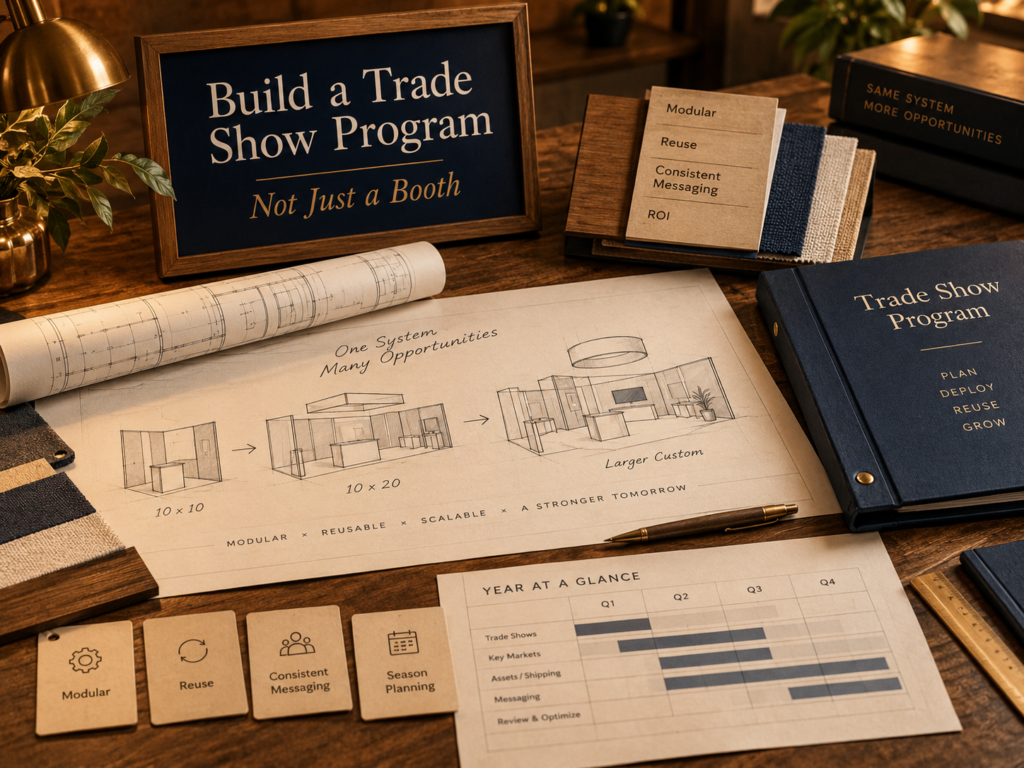
Instead of designing a completely new structure for every show, build a set of core modular components: a signature backwall system, reusable counters, a lighting package, structural elements that can be reconfigured for different booth sizes and floor plans. Show-specific elements get added on top, but the foundation doesn’t get rebuilt from scratch every time.
This isn’t just a cost-saving move, though it is that. It also means your team spends less time reinventing the wheel and more time refining what already works.
Keep messaging consistent across every show
A prospect who sees your booth at three different shows this year should recognize you as the same company each time — not feel like they’re meeting you for the first time, three times. That means your core messaging, your visual identity, and your value proposition need to travel with you show to show, even as specific graphics or callouts get tailored to each event’s audience.
Consistency compounds. Every repeat impression reinforces the last one instead of starting the recognition process over.
Plan to reuse, not rebuild, each season
The biggest mindset shift is this: before each show cycle, ask “what do we already have that we can use again?” before asking “what do we need to build new?” A modular program means most of what worked last season is still an asset this season — refreshed, not replaced.
That reuse-first approach is also what makes the difference between a marketing budget that resets every quarter and one that compounds. Assets built once and reused several times cost less per show than a new build every time, and they free up budget for the things that actually do need to be new — messaging updates, seasonal campaigns, a show-specific activation.
The result: ROI that compounds instead of resetting
When you build a program instead of a series of booths, each show gets a little more efficient than the last. Your team isn’t relearning logistics every time. Your booth isn’t starting from a blank page. And your brand shows up looking like it knows exactly what it’s doing — because, by this point, it does.
The bottom line
The question isn’t “how do we win this show?” It’s “how does this show make the next one easier?” That single shift in thinking is what separates a trade show program from a string of expensive one-offs.
Ready to build a program instead of planning show by show? [Reach out to our team] — we’ll help you map out a modular strategy that carries you through the whole season.